Showing posts with label silent films. Show all posts

Monday, August 22, 2016

The Darkness Among Us

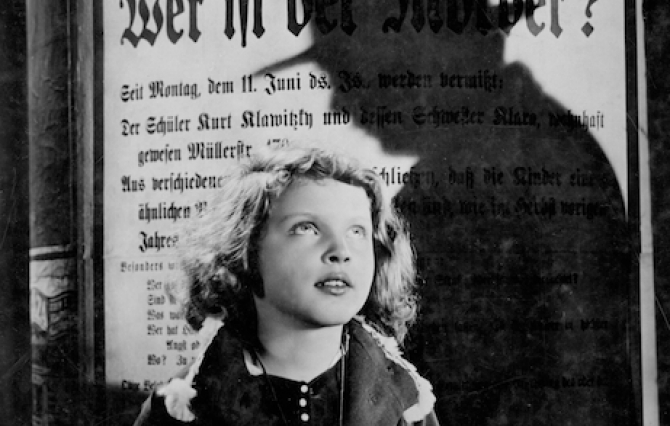
Taking a break from late-summer movies to re-visit a classic in this post - Fritz Lang's M. That's right, just one letter - M. Originally released in 1931 (and quickly banned by the Nazis once they took power in 1933), M is often hailed as both the first police procedural film and the first "serial killer" film. (So, for everyone who thinks old films have to be dusty and boring - you have just revealed yourself as someone who hasn't seen M. Go take care of that, won't you?) It's the film that made Peter Lorre, who until M was known as a comic actor, an overnight global star, albeit one associated with snivelling weasels of characters. Yes, it's in black-and-white and the dialogue is in German, so you have to read subtitles. Rise to the challenge - you won't regret it.

Fritz Lang's story of the hunt for a sadistic child killer is both less graphic and more creepy than many horror films made today. In 1931, filmmakers were still figuring out what film could do and in this, Lang's first "talkie," Lang uses sound to great effect. While only about two-thirds of the film has sound, that absence makes the other one-third otherworldly as we move abruptly from sound to silence. The identity of the murderer is never really in doubt - M is all about the fear engendered by a seemingly-ordinary fellow who has some sort of evil inside him that compels him to kill the most innocent among us. Stand-up citizens become hyper-alert, forming an impromptu mob when an elderly man is seen talking with a young girl on the street. The exhausted police force is willing to strong-arm citizens (both stand-up and otherwise) to uncover the monster preying on Berlin's children. The criminal underworld is outraged that they are being lumped in with an inhuman killing machine. Only the killer goes about his day, cheerfully whistling "In the Hall of the Mountain King" from Grieg's Peer Gynt. (By the way, the "stunt whistling" is done by Lang himself and this marked the first time a musical theme was used to identify a particular character - a trick used by opera for years.) M also asks two questions that have been around at least since Euripides' Medea - are those who kill children evil, or merely sick? And, in any event, what's to be done with them?


M is genuinely astonishing. Small details carry so much visual weight - the empty place set at the kitchen table, the detritus of the criminals' hasty scurrying-away from the office building in which the murderer has sought shelter, the dark shadows that hide the criminals' kangaroo court, The similarities between the police and the criminal underground as made obvious, both in common camera set-ups used by both and by shared character traits. (And smoking. Lots and lots of smoking.) Oh, and there actually was a sort of Beggars' Guild in Berlin at the time.

Part of what makes M such a standout film is the fact that it doesn't let us off the hook. Parents know there's a murderer on the loose, yet many children still wander around alone. Then parents are willing to rip an innocent man limb from limb without any sort of police presence. At its heart, M's lesson is that we're all responsible for each other - a lesson the Nazis rising to power in the waning days of the Weimar Republic, roundly ignored.

Sunday, September 16, 2012

Screen Dreams

Martin Scorsese making silents
As a movie fan, I'm sometimes surprised at how tricky it can be to make a movie about, well - movies.  Maybe it's the fear of too many "in jokes" that the crowd won't get, or maybe it's the fact that Hollywood often seems to have the attention span of a hyperactive gnat, but this is a genre of movies that seems to be pretty thin.  Mind you, often movies in this category are transcendent.  Altman's The Player is worth renting just for the opening shot (listen for the reference to Welles' Touch of Evil then go rent that) and I'll watch Singin' in the Rain just for O'Connor's "Make 'Em Laugh" sequence.

So why'd it take me the better part of a year to see Scorsese's Hugo? I have no answer, aside from the fact that the film was only at my local theater for a week, if that, when it was in big-screen release.  Ah, Hugo.  This was simply a lovely film. It helps if you have an appreciation for what it might have been like for the early pioneers of film, but even if you think silents are dull and boring (I disagree with you there, by the way), Hugo is a film to love.  Parts of the story are based on true events - which in and of itself is a sad thing.  We so often demand simple stories that immerse us in spectacle, but keep actual emotional content safely at arm's length.  Imagine, just for a moment, that you have never, ever seen a movie.  You've never seen images flicker and move on a screen in a darkened theater.  Then this technology comes along and suddenly, people are making stories that move.  For the price of a ticket, you can go to the bottom of the sea or to the moon (remember, it would be another seventy years before we actually knew what the moon looked like from human experience).

I fear we live in a cynical age which is often marked by being too cool to care - we've seen it all and done most of it and really, who cares?  Hugo makes you consider what it's like to care. Imagine going broke to the point of selling your life's work which is then melted down for scrap.  Imagine being an abandoned child trying desperately to stay hidden.  Then imagine finding refuge in a dim movie house.  Imagine being able to show that to your first friend.

The secret is the human ability to connect.  Movies have the power to do many things - and help us form many connections - and Scorsese knows this.  With Hugo, he created a beautifully crafted Valentine to the power of movies and to those who know the secret of this power, whether they are makers of movies or watchers of them.

Terry Pratchett captured this same sense of marvel in his Discworld novel Moving Pictures.  You know those primitive tribes who refuse to be photographed because of their fear that doing so might capture their soul?  Well, what if there's some sort of magic in making movies - and that magic wants to come into our world?  I've been a Pratchett fan since I was urged to read The Truth about seven years ago.  Pratchett writes great, complex fantasy novels that take place in a world that isn't nearly as nasty as Martin's Game of Thrones world (don't yell at me; I've read four of them, but I'm taking a break.  The random violence and misogyny got to me, even though I'm pretty sure it's there to make a point).  The Discworld is for people who enjoy sharp satire and clever writing - if that's you, go check out his work.  He has a new novel that's just come out - Dickens-based, from the title.  Not Discworld, but Pratchett's always worth a read.

Just as Georges Melies' silent films are worth a look.  From 1904 - The Mermaid