The "biopic" is an interesting product in the supermarket of film genres. For a biopic (that sounds snazzier than "biographical picture") to be successful, you need a subject who is ultimately likeable, has obstacles to overcome, and is some kind of positive role model. Society doesn't want us to glorify real life bad guys, so we usually either get fictional gangsters or, if they are "real life" bad guys, crime must not pay in the end.
The problem is one of balance. You don't want a purely goody-two-shoes subject, because we want to see our heroes have some kind of flaw that they must struggle to overcome. That makes them somehow easier to relate to. So you get any number of musical geniuses (examples include Johnny Cash, James Brown, and Ray Charles) who put the people who love them through hell before having some sort of epiphany. You also want there to be a struggle of some kind - maybe the subject has to overcome racism (Jackie Robinson, MLK), homophobia (Harvey Milk), mental illness (Howard Hughes) or systemic injustice (N.W.A.).
In the case of Sully, you get Tom Hanks as Capt. Chesley Sullenberger who managed to successfully bring a stricken Airbus down on the frigid Hudson River following multiple bird strikes which took out both of the jet's engines. There was no - repeat, NO - loss of life. Now, my father spent his career as a pilot, first with the Navy, then with Piedmont Airlines, and I remember clearly his admiration for Sully. (The airline Sully flew for was USAirways, which gobbled up Piedmont.) This was not just a difficult thing to do, it was impossible. And yet Sully managed it. The problem with Sully isn't that the story is far-fetched, it's that it isn't "fetched" enough. The moviemakers tried to gin up the drama by making the National Transportation Safety Board ("NTSB") members investigating the crash into the bad guys and it is entirely unnecessary. Events are also compressed to the point of being crushed - NTSB investigations take months and are very painstaking. In Sully, you can be excused for thinking that everything was done in about three weeks. Still, an interesting film, even if it has been "Hollywooded." Clint Eastwood directs, and does an admirable job, if you discount the final song over the credits, which just seems jarring.
Then you have Nina, a biopic starring Zoe Saldana as Nina Simone, a reluctant jazz star who only took to singing to pay for her classical piano studies. From the little western NC town of Tryon, Nina Simone was, for a time in the 60s, more famous for her civil rights stances than her music, and she was plenty famous for her music! Simone's voice was beyond distinctive and I was very much looking forward to this film.
It's a travesty. Awful. Wrong. Misses every single, solitary point. And I will admit that I did something I very rarely do, which is not finish it. The main relationship in the film never existed and Zoe Saldana plays the role in blackface. In 2016. If you must know more details of the problems in this fish wrapper of a movie, click here.
So instead, I watched What Happened, Miss Simone? which is a gorgeous documentary about Nina Simone. The title comes from an essay written by Maya Angelou and that only brushes the tip of the iceberg of what is extraordinary about this performer you've probably never heard of. Do yourself a favor and see this as soon as you can. Nina Simone was complicated, brilliant, self-destructive, used and a user. You won't necessarily like her all the time, but her music came from a place of truth, anger, joy, and tremendous beauty.
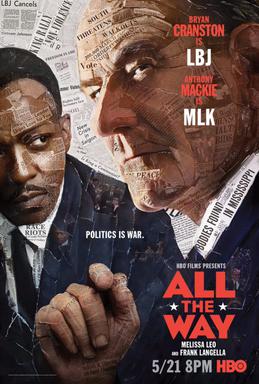
Someone else who you won't like all the time is Lyndon Baines Johnson, the "accidental president" who stepped into the Oval Office following the assassination of JFK. Kennedy was the golden boy, all youth and good looks and carefully-constructed image. LBJ, on the other hand, was the old Texas warhorse who had been carefully accumulating markers on Capitol Hill. Suddenly, this rough-edged politician was thrust into the glare of the spotlight and needed to make good on Kennedy's high-flying promises, which included the Civil Rights Act. Maybe only LBJ, with his decades of maneuvering, glad-handing, and not-so-subtle pressure, could have delivered on that, but he went far beyond it. The Voting Rights Act, the Clean Air Act, the Clean Water Act, Head Start - these are but a few of the "Great Society" programs that LBJ championed and, in so doing, transformed America. The escalation of Vietnam marred his legacy, however. Those events occur after the time period covered in All the Way, the film based on the Tony Award-winning play starring Bryan Cranston, tells the story of the first year of the LBJ presidency, going from that dread day in Dallas to LBJ's election a year later. It's powerful moviemaking and well worth seeing. LBJ could be a cast-iron sonofabitch, but politics at that level isn't for the meek. A magnificent supporting cast makes this a must-see, especially during this election cycle.
Sorry - due to a number of converging deadlines, the poor blog has been left unattended for longer than it should have been. Rest assured that I've been writing posts in my head; they just haven't made it to the page!
I'm so far behind that I'm going to break this into two posts. Today, I'll touch on two films that I've seen recently that are well worth seeking out and in a day or two, I'll catch you up on some biopics/documentaries.
Now that we understand the outline (see what I did there?), let's talk about Kubo and the Two Strings, which you are going to seek out immediately. Kubo comes from the fine folk at Laika, a studio dedicated to producing fine stop-motion animation. Since this particular form of animation is so incredibly time-consuming, Laika has produced only a handful of films in its ten-year existence - Coraline, ParaNorman, The Boxtrolls, and now Kubo. While all the films have had their high points, in Kubo, everything comes together. The animation is first-rate and the story - well. Kubo's tale begins, "If you must blink - do it now." It's a story about stories - those we tell others, those we tell ourselves, and those we create to explain things. Featuring Charlize Theron, Ralph Fiennes, and Matthew McConaughey, Kubo is an astonishing film and certainly the highlight of my summer.
Skip Suicide Squad, which can't figure out which of half a dozen stories it wants to tell, and seek out this absolute gem about family, loss, and the power of tales.
Tom Hanks is a movie star. There's no doubt about that - attaching his name to a project carries a certain cachet and his projects tend to be box office gold. A Hologram for the King is an anomaly, for it's a teensy independent film that you're going to have to dig a little to find (let me help with that - check your local library!) Hologram is worth seeking out just to see the outline of what could have been a fantastic film. Based on a Dave Eggers novel, Hologram tells the story of Alan Clay, a down-on-his-luck salesman who is barely a step above Arthur Miller's Willy Loman. Things aren't going well for Alan - his marriage is dissolving, his career is floundering, leading his daughter to take a semester off from college until her tuition can be worked out, and everything is riding on this sale of high-tech to the Saudi king, who is in no hurry at all to meet with him and his team, who are stuck in a drafty tent in the desert just waiting. And waiting. And waiting. This fish-out-of-water tale is not without its flaws, but it has a certain charm, as well. This is due in part to Hanks' own abilities as an actor, but also to those in smaller roles, such as Alexander Black as Yousef, a free-lance cab driver who shows Alan the topsy-turviness of Saudi society, which boasts lavish wealth along with a regime so repressive women are not allowed to drive and are subject to intense social backlash just for being in a room alone with a man. Outstanding in portraying the down-the-rabbit-hole situations that leads to is Sarita Choudhury as Zahra, a Saudi doctor who shares some of the sorrowful circumstances enveloping Alan. Neither of these are Saudi actors, which seems to be a shame. Then again - it is a repressive regime. This is a quiet film, which might explain its lack of box office appeal. American audiences often don't like "quiet" much. Give it a try, won't you?
Somehow, I've gotten terribly behind with the blog, so I have to double up a bit in this post. I want to briefly discuss two new releases and one that's available outside of theaters. What all three films have in common is a certain "scare" factor.
First, Ridley Scott's The Martian, which focuses on the triple fears of isolation, abandonment, and impending doom. Based on Andy Weir's captivating 2011 novel of the same name, Scott assembles a star-studded cast (Jeff Daniels, Jessica Chastain, Kristen Wiig, Michael Pena, and Chiwetel Ejiofor, among others) to tell the story of Mark Watney, an American astronaut who gets left behind when a Mars mission goes terribly wrong. I think Matt Damon captures Watney's wry wit - there's a bit about Watney being a "space pirate" that's laugh-out-loud funny, for example. However, the film cuts out a good deal of the problem-solving that made the novel so compelling and, in a few places, just gets things flat-out wrong. (No, you can't use a teensy hole in your spacesuit to guide you toward your rescue ship, mostly because you'd have a bad case of the deads.) Weir likes science - in fact, he claims science makes a wonderful plot device - and it's a bit of a shame to see that serious thinking watered-down to a basic thrills-and-adventure plot. Nevertheless, I enjoyed the film and would love to see it spark interest in manned space missions again. Seriously, why don't we have a moon base yet?
Second, Steven Spielberg's Bridge of Spies, which deals with the fear of trickery, war, and back-door deals. Okay, look - you pretty much can't go wrong with the combination of Tom Hanks, Spielberg, and American can-do attitude. In addition to working with Hanks on a number of other projects as producer, Spielberg has directed Hanks in Saving Private Ryan (where we also had to rescue Matt Damon - between that and Interstellar, Damon ought to just stay home by the fire), Catch Me If You Can, and The Terminal. Here, Hanks is in full Jimmy Stewart mode and by that, I mean he's playing a solid, honest, decent man (James Donovan) who is convinced that the rule of law will lead to the light. When called upon to defend a Soviet national accused of espionage at the height of the Cold War, he takes the unwelcome assignment (he's an insurance attorney, not a high-powered government lawyer, which is an interesting story in itself) because he truly believes that the Constitution's guarantee of a competent defense is a cornerstone of our legal system. (He's right, by the way.) His client is guilty as original sin, but Donovan's arguments spare his client the death penalty. A few years later, the pilot of one of our super-duper-top-secret U2 spy planes is shot down and Donovan is called into service to arrange for a prisoner exchange. Bridge of Spies is a compelling movie and it's at its absolute best detailing Donovan's tense days in Berlin arranging the spy swap at the very time the Berlin Wall is going up. Sure, the film takes a few liberties with the story (and there's far too little smoking for the time period!), but an amazing film and one well worth seeing in these cynical times.
Lastly, the 2014 Australian horror-thriller The Babadook. I can't say much about this without worrying about giving something important away, so I'll be brief. This film, the first major release by Jennifer Kent, scared the bejeezus out of me. There's a bit of gore, but it's mostly "head scare" and reality gets very, very warped in the hour and a half run time. One thing this film does masterfully is set you off-kilter. My allegiances changed as I started the film sympathizing with one character and found myself moving to viewing that character as the Evil of the film. What's real? What's the mind capable of believing? And how much can untreated traumas manifest in our world? The Babadook is a film that made me cringe, jump, and actually think - and many others agree with me. Don't miss this one.
Well, of course I think stories matter - I spend an inordinate amount of time writing about them, especially the televisual kind. But it's an undeniable truth - stories matter. They are cautionary and tall tales, spun for the amusement of the audience and the instruction of same. Fairy tales tell us the perils of straying from the path, family tales remind us of why Sissy has that thin scar on her eyebrow, and national tales teach us the values we as a society hold dear.
With all that in mind, run, do not walk, to see Saving Mr. Banks. I have not seen Disney's Mary Poppins in many a year and I knew nothing of the history behind the books. Saving Mr. Banks made me want to stop at the video store on the way home to rent Mary Poppins and I'm pretty sure at some point in the future when I'm in a particularly mule-headed mood, my husband's going to look at me and say, "Get on the horse, Pamela."
Tom Hanks is wonderful as Walt Disney (seriously - is there nothing the man can't do?), a man who has built an empire on a cartoon mouse, yet hasn't managed to convince a spinster author to let him make a movie from her stories. The film has an extraordinary supporting cast and you'll see many familiar faces, but the shining star of this film is Emma Thompson as P.L. Travers. Her Travers is stern, borderline rude, and nearly unlikable, all of which could have made her into a broadly-sketched caricature, but in Thompson's skillful, subtle hands, Travers is sympathetic and we see the harshness as a sort of protective shell. (Colin Farrell has a good bit to do with that, as well.)
I could go on and on about this one. Suffice it to say that I found myself tearing up at some hard truths that the film tells. Children are resilient and they often move forward more successfully than adults, who so often break when they look back.
Does it take liberties with the truth? Of course it does- this is a tale, after all. Then again, there is more than one kind of truth - a fact that all storytellers understand automatically. Saving Mr. Banks is a beautiful tale, well told.
When looking for all-around good guys in Hollywood, it's hard to beat Tom Hanks. His latest film, Captain Phillips, solidifies his reputation as a stellar actor as well. There's been some criticism that Phillips' memoir makes him look more heroic than he actually was and, in fact, he's being sued by some of his crew who allege he created the dangerous situation in the first place. That's for a court of law to sort out, but the movie itself is fantastic! (And this falls squarely within the parameters of "it's not pretending to be a documentary, and don't get your history from movies." Go do some research on the actual events and make up your own mind on that - I'm limiting my comments here to the film.)
I wasn't sure about this one - I remember the actual hijacking back in the spring of 2009 and I remember how it ended, so I wasn't sure how compelling the movie would be. (I know that's not a great argument - I go see Shakespeare plays all the time when I know how they'll end, so . . .) But I was amazed that I caught myself holding my breath with tension. Paul Greengrass, who is best known for the Bourne movies, as well as another film inspired by actual events, United 93, does a masterful job of ratcheting up the action. (A little too much shaky-cam for my taste, though - I want this trend to go ahead and pass.) He uses an interesting framing device at the start of the film as you see Phillips and Muse, who will become the head pirate, both essentially getting ready for work. The film does a very nice job of not creating cookie-cutter villains, but instead rounding them out and presenting the audience with a more nuanced view. These are not dashing, wear-a-stuffed-parrot pirates; these are desperate, frightened, hungry men, often half out of their minds on large amounts of khat, and they are not acting as a unified, well-trained team. It's nearly a miracle no one gets badly hurt earlier. Greengrass even generated some sympathy in me for the plight the pirates are in - Somalia is essentially a failed state and people want to survive - but, at the end of the day, I'm rooting for Team Hanks. (But don't overlook Barkhad Abdi, who plays Muse. First time out of the gate, and he holds his own with Hanks.)
Captain Phillips was made with the cooperation of the U.S. Navy and other government agencies, so naturally they appear well-trained, calm, and frighteningly efficient. One of the takeaway messages of this movie is definitely "Don't mess with the U.S. military." My father was a Navy pilot, so I heartily endorse this message. The Navy and the SEALS aren't reckless cowboy types - they've got a job to do and by golly, they're going to do it. Hanks' Phillips is a man in a situation that's spiraling rapidly out of control and he's trying hard to stay calm and stay alive, but he was never trained for this - the military personnel were and the final few minutes, when that contrast is made sharply evident, completely sold me on Hanks' acting.
If you're looking for a great thriller, this is the movie for you.
It's best to begin by a straight-up admission that I wasn't at all sure about this one.Cloud Atlasis long - like Gone with the Wind long and, for the most part, contemporary audiences get antsy around the one-hour-and-forty-five-minute mark. It involves actors playing multiple roles across multiple storylines, switching time periods, races, and genders. The film has come under fire for "yellowfacing" - having Caucasian actors play Asian characters rather than hiring Asian actors. There are three - THREE - directors, two of whom are the Wachowski siblings, who once were the Wachowski brothers and that's a whole other kettle of mackerel that I'm not getting into, aside from saying that I imagine that Lana Wachowski has a unique perspective on just how much a person can change. The Wachowski siblings have a track record that shows a definite bent for visually striking films that dabble in theology and Big Questions.
Not sure, not sure. But this is my not-quite-job, so I bought my ticket, not at all sure if this was going to be the firstMatrix movie or Speed Racer. (Hey, like your career hasn't had the occasional misstep?)
I have to say, I've never seen anything like this movie. Ever. I think it's absolutely brilliant and let me explain why.
All too often today, films lack ambition. Worse, they don't trust the audience to figure anything out, so the storytelling tends to be "tell," rather than "show." Cloud Atlas trusts you to be able to connect the dots (by the way, a "cloud atlas" is a real thing) and expects you to try. It's not about stunt casting, although some will seize on that, since you have Tom Hanks, Halle Berry, Jim Broadbent, Hugh Grant, and the incomparable Hugo Weaving (among at least half a dozen others) playing multiple roles. The key concept in the movie is that things, events, people, and (most importantly) love, repeat throughout time. Who's playing the "good guy" and who's filling the archetype of the villain might change, but the roles are always there because we have a hard time learning our lessons. There's certainly some Carl Jung in here - I caught myself mulling over the concept of archetypes and the collective unconscious after the credits ran. And Joseph Campbell would swoon over this film. Swoon.
Some will balk at the length. Some will balk at the pidgin language used in one part. Some will balk at the mixing of time periods.
I think all of these people are missing the point. Cloud Atlas is huge and glorious and celebratory (there's a scene in a Scottish pub that had me punching the air in my seat) and tragic and funny and will both make you glad to be human and sorry to be associated with such a screwed-up species.
Go see it.
Oh, and about the pidgin language part. I've read some criticism that griped that this part should come with subtitles. Really, buddy? Stop taking snarky notes on your popcorn bucket and try concentrating. (I know - that was snarky. Trust me, it was deserved.)
And about the time switches. Just pay attention - the time period switches aren't random at all. They occur when a significant plot point is reached in the Grand Story. That's one of the key points - life is the same story told over and over. It actually reminded me of John Gardner's line that "in all the world, there are only two stories. You take a trip, or a stranger comes to town." (And Gardner showed in Grendel that he understands the power of telling a familiar tale through the lens of another character - he'd probably like Cloud Atlas just fine for that reason alone.) Honestly, if you ever teach any sort of narrative structure class - playwrighting, screenwriting, or just plain ol' longhand fiction - Cloud Atlas could be a great film to use as a teaching tool, for it shows the same big events multiple times.
To sum up, Cloud Atlas is a movie for viewers who are willing to settle in for a long ride, who aren't afraid to think and who can still marvel at the way a movie can touch us emotionally. All that said, Cloud Atlas isn't for everyone - and it certainly doesn't make you a dunderhead if you decide it's not your cup of sweet tea.