What a year it's been! There seem to have been more losses in the film world (not to mention the "real world") than are either usual or warranted. For Babylon 5 fans, the loss of Jerry Doyle hit especially hard, and the fact that he and Garibaldi had so many similarities is a cause for great sadness.
I know that I have not been a faithful correspondent this year and I vow to do better in 2017. This year was just cram-packed with things that took me away from this blog, which is - in the final analysis - a labor of love, rather than a paying gig. And bills (like pipers) must be paid. That being said, Rogue One and Moana - I loved you both and you deserved full write-ups.
However, 2016 also brought the delayed-by-cancer completion of Dreams Given Form. Ensley and I are in the copy-editing phase, having sent off the publication catalog blurb. We still have work to do, but we are firmly in the final stages and Dreams Given Form will be given form in 2017! And really - I cannot say enough good things about ECW's support for this project. There are some publishing houses who would've reacted to my diagnosis by saying, "That's awful! So you can't make the contract deadline. Hmm - well, you get better and we're passing on the book." ECW never wavered in their support and I hope the book sells truckloads to reward them for their loyalty. (Do what you can on that, won't you?)
In the final week of 2016, I hope to see both Fences and Hidden Figures. And how great was it to come out of a store after making a candy cane run to have someone holler at me from a parked car, "Fences. Yeah, Fences. Worth seeing?" When I said I hadn't seen it yet - Meet Me at the Movies doesn't get advance screenings - he cheerfully asked, "Okay, then. What about Rogue One?"
Movies bring people together. So please - watch us on TV19! New episodes every Friday and you can watch us anywhere in the world through streaming! Just go to clevelandcc.edu and select CTV19 at the top of your screen. That'll take you to all the fabulous TV19 shows that stream - we're the first one on the left!
And Merry Christmas to you all! May 2017 be wondrous to all of us!
In the last several weeks, I've seen a number of films, but haven't gotten around to writing them up. Well, that'll happen sometimes. Suffice it to say that most of what I've seen (from Dr. Strange to Edge of Seventeen) has been okay, but nothing that totally made me glad I'd seen it on the big screen. Other critics have mooned over these while I just -- didn't. Maybe it's end-of-semester doldrums; I don't know.
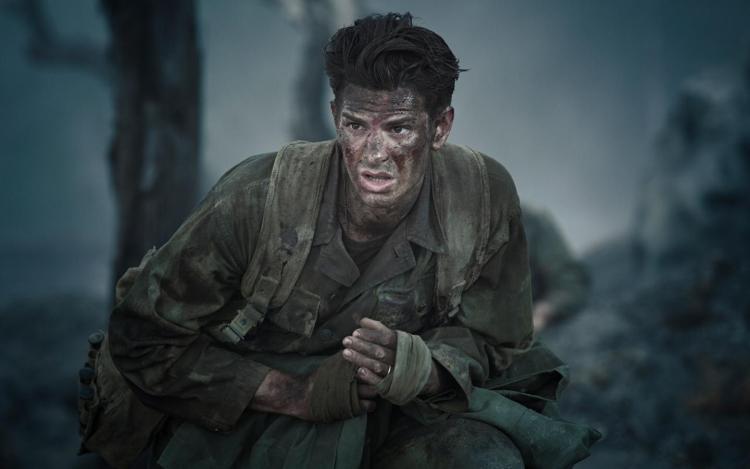
But there was an exception. Hacksaw Ridge. If you are old enough (do NOT take children to this - it's a "hard R" for graphic war violence, on the Saving Private Ryan opening scene level), go see this, then immediately put it on your "must buy" list.
Heaven knows, I've got my problems with Mel Gibson (one movie I've recently seen and loved was Peter Weir's Gallipoli, which stars a shockingly young Gibson), both in his on and off screen efforts. Let's limit this to onscreen - the man likes violence and has a penchant for lovingly filming horrific violence being done to his characters (Braveheart, I'm looking at you. You, too, Passion of the Christ). What lets him do this is the fact that he knows how to tell a story effectively and in Hacksaw Ridge, he's in top form.
Hacksaw Ridge tells the slightly fictionalized story of Desmond Doss (played so very well by Andrew Garfield), a Seventh-Day Adventist who enlisted during WW2 to become a medic. Due to his faith, he refused to so much as touch a gun, which made basic training very, very difficult. During the lengthy hellscape that was the Battle of Okinawa, Doss showed his courage time and time again as he rescued dozens of wounded men from certain death. In fact, some of his story is left out because the actual facts seem too incredible to believe - I encourage you to click here for the details comparing the movie to "real life." For his efforts, he was awarded the Medal of Honor, which they do not give out for perfect attendance.
In short, Doss held tight to his belief that it was both wrong to kill and imperative that he serve his country during wartime. How to balance those two competing beliefs makes for a compelling story.
So sorry! After finishing the draft, I took a little time off from the blog, then there were edits and other work-related tasks, then the house was overtaken by the Dread Specter of Minor Illness. Not content with hosting that jackass, I managed to catch poison ivy while hiking on a gorgeous late October day, then scratched it to a state of infection. Party at my place - I've got steroids and antibiotics! Woo-hoo!
Rather than detail everything I've watched in the last month, let me just hit a few highlights. There will be more to add to this, since I'm confined to the house for a few days with this low-grade plague which means "movie time" for me.
When they announced a remake of The Magnificent Seven, I wasn't so sure and I was right to be skeptical. Look, it's a decent enough little Western, but geez. Do yourself a real favor and get your hands on Kurosawa's 1954 masterwork Seven Samurai(Toshiro Mifune is a knockout) and watch that. Then get the original Magnificent Seven (Yul Brynner and Steve McQueen, among many, many others) from 1960 and watch that. Now don't bother with the remake.
The key to the two source films is how they view the peasant/farmers. The age of the samurai/ gunslinger is passing, but those who work the earth will continue and endure. They might not get the glory, but they win. That core is missing from the remake, which is all action/adventure (and plot holes you could stampede cattle through), but really - there's no heart there. (Which is a shame when you have Ethan Hawke playing a dandy with the unforgettable Cajun name of "Goodnight Robicheaux.") Also, it sometimes shocks me how much more progressive Kurosawa could be with female characters sixty years ago.
Speaking of classics, I indulged in the Bette Davis melodrama Hush, Hush Sweet Charlotte which is a must-see for lovers of Southern Gothic. Crumbling mansion, eccentric-to-the-point-of-crazy rich recluse, Spanish moss, grisly murder - AND Olivia de Havilland! We just don't make 'em like this anymore.
For Halloween, I finally saw What We Do in the Shadows, a 2014 New Zealand movie that can best be described as Interview with the Vampire meets The Real World. If you're in the mood for a vampire movie that is far more canny and fun than it has any right to be, this one's for you. Watch the trailer below for a taste.
OK - I should be getting back to a far more regular schedule - thanks for the break!
Okay, okay - so it's not Thursday. There was NO WAY I was going to wait!
For you see, I have exciting news that I cannot keep to myself - the manuscript draft for Dreams Given Form: The Unofficial Guide to the Babylon 5 Universe is done!Done! DONE!!!!As in, the final bits were sent to our editor today! As in, so recently that my final Post-It notes and flags are still stuck to the edge of my desk where I put them as I finished with each portion they were marking in the final few days of drafting.
Whew.
Now, there's still work to be done that will take a minimum of several months. We've been sending each "chunk" to our editor as we finished it, so a good portion has already gone through the initial edits, but remember that Dreams Given Form is an ambitious piece of work that brings together everything that has been designated as canonical for Babylon 5 - the episodes, the movies, Crusade, the novels, the comics, and the short stories, as well as some "extras." (I drew the line at action figures . . .) That made for a crazy amount of work, even with wonderful materials such as The Lurker's Guide and Terry Jones' exhaustive chronology, which was so detailed it was adopted by the production company to keep timelines straight. (I swear, the implications of "War without End" on later works nearly drove me to tears a couple of times and Terry saved my bacon.)
Plus, this project came to a screeching halt when I was diagnosed with ductal carcinoma in situ (think "junior auxiliary breast cancer") until I completed radiation treatment and got my strength and energy levels back. (Imagine a disease in which voluntarily subjecting yourself to radiation sickness is the best scenario and you'll understand why research and writing fell low on the list.) So publication was delayed, but it's all in the editing stage now!
We weren't able to reach one goal - we wanted to get the rights to reprint the six canonical short stories since they've never been collected in one place, but Warner Brothers has no interest in that, which is their prerogative as the copyright holder. Still, we include summaries, analysis, and highlights from each of those in Dreams Given Form. Also, we still have a few interview requests out there and we have our fingers crossed, but those chips will fall where they may.
We'll start conversations with our publisher, ECW Press, about cover design and possible sites to promote the book, which will be available in 2017 - we'll announce specific details when we know more.
For now, though, I think Ensley and I have some serious celebrating to do, because right now, everybody's cute. And in purple, I'm stunning.
The "biopic" is an interesting product in the supermarket of film genres. For a biopic (that sounds snazzier than "biographical picture") to be successful, you need a subject who is ultimately likeable, has obstacles to overcome, and is some kind of positive role model. Society doesn't want us to glorify real life bad guys, so we usually either get fictional gangsters or, if they are "real life" bad guys, crime must not pay in the end.
The problem is one of balance. You don't want a purely goody-two-shoes subject, because we want to see our heroes have some kind of flaw that they must struggle to overcome. That makes them somehow easier to relate to. So you get any number of musical geniuses (examples include Johnny Cash, James Brown, and Ray Charles) who put the people who love them through hell before having some sort of epiphany. You also want there to be a struggle of some kind - maybe the subject has to overcome racism (Jackie Robinson, MLK), homophobia (Harvey Milk), mental illness (Howard Hughes) or systemic injustice (N.W.A.).
In the case of Sully, you get Tom Hanks as Capt. Chesley Sullenberger who managed to successfully bring a stricken Airbus down on the frigid Hudson River following multiple bird strikes which took out both of the jet's engines. There was no - repeat, NO - loss of life. Now, my father spent his career as a pilot, first with the Navy, then with Piedmont Airlines, and I remember clearly his admiration for Sully. (The airline Sully flew for was USAirways, which gobbled up Piedmont.) This was not just a difficult thing to do, it was impossible. And yet Sully managed it. The problem with Sully isn't that the story is far-fetched, it's that it isn't "fetched" enough. The moviemakers tried to gin up the drama by making the National Transportation Safety Board ("NTSB") members investigating the crash into the bad guys and it is entirely unnecessary. Events are also compressed to the point of being crushed - NTSB investigations take months and are very painstaking. In Sully, you can be excused for thinking that everything was done in about three weeks. Still, an interesting film, even if it has been "Hollywooded." Clint Eastwood directs, and does an admirable job, if you discount the final song over the credits, which just seems jarring.
Then you have Nina, a biopic starring Zoe Saldana as Nina Simone, a reluctant jazz star who only took to singing to pay for her classical piano studies. From the little western NC town of Tryon, Nina Simone was, for a time in the 60s, more famous for her civil rights stances than her music, and she was plenty famous for her music! Simone's voice was beyond distinctive and I was very much looking forward to this film.
It's a travesty. Awful. Wrong. Misses every single, solitary point. And I will admit that I did something I very rarely do, which is not finish it. The main relationship in the film never existed and Zoe Saldana plays the role in blackface. In 2016. If you must know more details of the problems in this fish wrapper of a movie, click here.
So instead, I watched What Happened, Miss Simone? which is a gorgeous documentary about Nina Simone. The title comes from an essay written by Maya Angelou and that only brushes the tip of the iceberg of what is extraordinary about this performer you've probably never heard of. Do yourself a favor and see this as soon as you can. Nina Simone was complicated, brilliant, self-destructive, used and a user. You won't necessarily like her all the time, but her music came from a place of truth, anger, joy, and tremendous beauty.
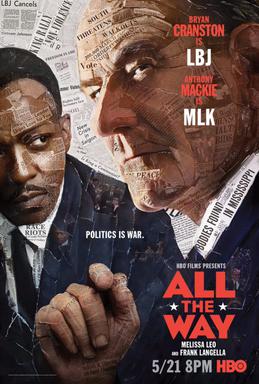
Someone else who you won't like all the time is Lyndon Baines Johnson, the "accidental president" who stepped into the Oval Office following the assassination of JFK. Kennedy was the golden boy, all youth and good looks and carefully-constructed image. LBJ, on the other hand, was the old Texas warhorse who had been carefully accumulating markers on Capitol Hill. Suddenly, this rough-edged politician was thrust into the glare of the spotlight and needed to make good on Kennedy's high-flying promises, which included the Civil Rights Act. Maybe only LBJ, with his decades of maneuvering, glad-handing, and not-so-subtle pressure, could have delivered on that, but he went far beyond it. The Voting Rights Act, the Clean Air Act, the Clean Water Act, Head Start - these are but a few of the "Great Society" programs that LBJ championed and, in so doing, transformed America. The escalation of Vietnam marred his legacy, however. Those events occur after the time period covered in All the Way, the film based on the Tony Award-winning play starring Bryan Cranston, tells the story of the first year of the LBJ presidency, going from that dread day in Dallas to LBJ's election a year later. It's powerful moviemaking and well worth seeing. LBJ could be a cast-iron sonofabitch, but politics at that level isn't for the meek. A magnificent supporting cast makes this a must-see, especially during this election cycle.
 What a year it's been! There seem to have been more losses in the film world (not to mention the "real world") than are either usual or warranted. For Babylon 5 fans, the loss of Jerry Doyle hit especially hard, and the fact that he and Garibaldi had so many similarities is a cause for great sadness.